Stephen's Forgetful Fish Page
I can stop anytime I like.
I like building decks. Sometimes I get carried away. This was one of those times; below, you'll find a variety of Forgetful Fish-adjacent decks, some closer to Nick Floyd's original vision than others.
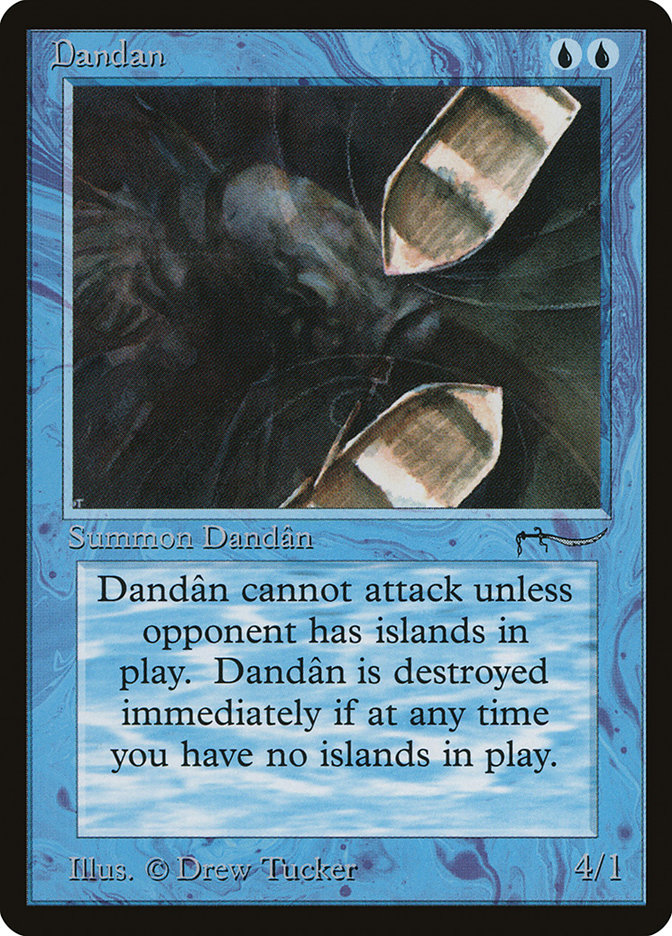
In essence, Forgetful Fish (also eponymously known as Dandân) is a shared deck format, where players fight to manipulate the top of the deck while trying to kill each other with a weird creature from the dawn of magic; there's a nice intro by Harry Becker here.
It has been getting really popular of late, following a video by Rhystic Studies, a subreddit and even has tournaments now! It's a great game for two players, and it helps that the Dandân art is by one of my favourite artists, Drew Tucker, who has been adding a bit of class to Magic illustration since the first sets back in 1993! The Dandân shows a gigantic fish lurking below the surface of a lake, perfect for a game with such hidden depths.
When assembling these decks, I've used both Nick Floyd's original document and Callahan Jones' thoughtful analysis as inspiration, before blithely ignoring them and running off with the ball.
On to the Elephant in the room, searching your deck. The searching player can count the shared deck and work out exactly what is in their opponent's hand; and
that's
very
blue
indeed.
It does, however, slow the game down. My recommended solution is that when a player searches the library, their opponent immediately reveals their hand. This removes the need to count and saves a lot of time if players are serious about their Forgetful Fish. An alternate solution you could use by mutual agreement is to remove 4 random cards face down at the start of the game to prevent an accurate count.
Update: I just found out that Nick Floyd has a youtube channel.
... the dendan, which is the biggest of all fish and the fellest of our foes. Its bulk is greater than that of any beast of the land, and were it to meet a camel or an elephant, it would swallow it at one mouthful... "Abdullah the Fisherman and Abdullah the Merman", The Book of One Thousand and One Nights, John Payne translation.
The Decks (Minor Variations)
The Decks (Major Variations)
Not My Decks
Dory (REALLY Forgetful Fish)
A bit of fun; the card names have been selected for memory related references - there are a surprising quantity!
Old Frame Forgetful Fish
In this mono-blue build, all cards are black border old-frame versions. It's not quite a Premodern build since I'm taking advantage of the nostalgia old frame reprints from later sets. I've also emphasised the water theme as much as possible in the card art.
Premodern Forgetful Fish
In this mono-blue build, all cards are black border old-frame versions. It's not quite a Premodern build since I'm taking advantage of the nostalgia old frame reprints from later sets. I've also emphasised the water theme as much as possible in the card art.
Whitewater Fish (White Border, Dandân)
All cards are white bordered; this I play this version unsleeved and carry it around in my pocket wrapped in an elastic band :). The limited card pool makes this build a little slower, but that's not necessarily a bad thing. Again, I've emphasised the water theme in the card art where possible.
Coelocanth (A2A, Dandân)
This is a Forgetful Fish build using only early cards legal in the Alpha to Alliances format. Despite the small card pool, Memory Lapse and Dandan are both present; the only thing really missing here are Foreshadow/Predict shenanigans.
Ostracoderm (Swedish 93/94 Oldschool, Dandân)
This is a Forgetful Fish build using only early cards legal in the Swedish 93/94 Oldschool format. Lots of key cards are missing here, so it's more oldschool than Forgetful Fish. See also my Sushi deck, which I think works better given the format restrictions.
Rebecca Guay (Sea Drake)
This is a tribute to Rebecca Guay, one of the greatest Magic Artists; she illustrated Predict and the Mirage version of Memory Lapse, so we're off to a good start. The creature I've chosen, Sea Drake, was once so pushed that it even saw Vintage play and commanded prices of around £50. These days, it's a £1 card. To mitigate the bouncing your lands thing, I'd suggest playing as if each player has a copy of Titania (Vanguard) in play. This increases your starting hand size to 9, sets your life total to 15, and allows you to play two lands per turn.
Rebecca Guay is known for her elves and enchantments, neither of which really fit here but I've added a little enchantment subgame to showcase some of her art, in the form of 4 iconic global enchantments which switch up the rules of the game. These are 1-offs with symmetrical effects, which you'll find in the "considering" section on moxfield.
Mark Tedin
A forgetful-fish-adjacent shared library deck, using Mark Tedin's artwork only.
Sushi
This is a Swedish 93/94 build. As a result there's no Memory Lapse and without the topdeck shenanigans it plays out more like oldschool than Dandan; but there are sill some interesting interactions and the possibility of big complicated stacks. I'll be taking it along to the next Brothers of Fire event.
Caviar
This deck is based around Biolume Egg, a 0/4 defender which comes back as a 4/4 serpent only when sacrificed. The challenge here is that there aren't a lot of blue cards which let you sacrifice things; and of those, the Casualty mechanism is useless because you need a creature with power >= 1 sob! I've removed a lot of the bounce effects from this version, since the challenge of cracking your eggs is enough that you don't want them to just go straight back to your hand afterwards. Given the whole 'biolume' thing, I've aimed for cards with glowing blue art where possible.
Suicide Squad
A deck built around Brackwater Elemental - a card that dies after attacking or blocking. The support cards in this build revolve around keeping the blasted thing alive :)
Dead Fish
The fish have been replaced with Demilich, who likes a nice big graveyard to plunder :). As a result, cards are going to end up in the graveyard faster and the game is likely to end much sooner. I've tried to make art choices which emphasise the horror motifs as befits a floating skull, but not at the expense of game play.
Fish Fingers and Custard
This is the least Forgetful fish-y deck of all. A Doctor who-themed build built around the suspend mechanism and time travel. It's surprisingly fast. Enjoy!
Wolffish (Ulvenwald Captive)
Erik Dragon Highlander created Colorless, White, Black and Red Decks; I thought I'd complete the cycle with a green deck. Or two. This one is built around Ulvenwald Captive, a werewolf that can't attack until it transforms. Annoyingly, it;s a creature with toughness greater than its power, which can lead to stand-offs; look for ways to break the symmetry!
A Deadly Education (Strixhaven, planebound, fractals)
This is a Strixhaven planebound shared deck variant. Why? Mostly because the Strixhaven Mystical Archive cards are gorgeous, and need a deck to show them off :)
With such a restricted card pool, I gave myself permission to break all the usual rules. In particular, life totals can't be tracked with a d6 because (a) the creatures (fractals) have variable sizes, and (b) there's a certain amount of lifegain to boot. I'm hoping for more options after Secrets of Strixhaven in 2026.
The deck is named for the first book of Naomi Novik's Scholomance series - highly recommended!
Barrow Ghoul (Barrow Ghoul)
Erik Dragon Highlander created a Barrow Ghoul deck; I've played this some, and have tweaked it in line with my preferences - more two-offs, as per standard Forgetful Fish and I removed the lifegain so you're more likely to win through combat damage.
Oath Roulette
Chansterling came up with the wonderful idea of Oath Roulette - start with Oath of Druids and a stupid quantity of Forbidden Orchard, then have players flipping into random creatures each turn! This is my build, with my choice of creatures since I thought the original selection was overpowered somewhat.